
Automotive Elegance

What is VLT?

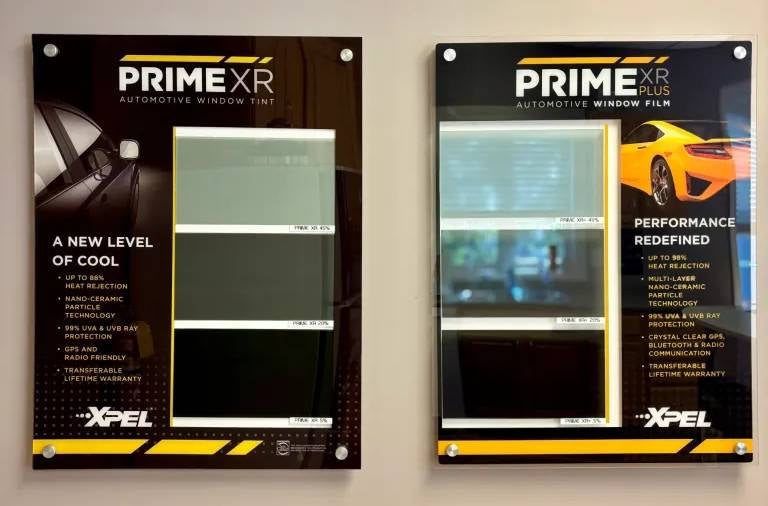
When discussing window tint, you’ll frequently hear about “VLT percentages.” VLT stands for Visible Light Transmitted, and it’s the most crucial factor determining how dark your window tint will appear. Simply put, the VLT percentage indicates how much visible light is allowed to pass through the tinted window.

  • Higher VLT percentage = Lighter tint (more light passes through). For example, 70% VLT means 70% of visible light gets through, making the tint very light, almost clear.
  • Lower VLT percentage = Darker tint (less light passes through). For example, 5% VLT means only 5% of visible light gets through, resulting in a very dark, opaque appearance.
A red surface, split vertically. The left side, labeled Protected with XPEL film, is smooth. The right, Unprotected, is heavily scratched.

The Spectrum of Darkness and Its Impact

  • 70% VLT (Very Light/Clear)
    • Appearance: Often looks nearly invisible, especially on factory-tinted windows. It offers all the benefits of UV and heat rejection without significant darkening.
    • Visibility: Unimpeded outward visibility, day or night.
    • Primary Use: Ideal for windshields (where regulations are strictest) or for those who desire protection without altering the vehicle’s appearance.
  • 45% VLT (Subtle Enhancement)
    • Appearance: A very subtle, factory-like tint. The windows are no longer completely clear but are not noticeably dark.
    • Visibility: Minimal impact on outward visibility, even at night.
    • Primary Use: Provides glare reduction, heat rejection, and a touch of privacy without drawing too much attention.
  • 20% VLT (Significant Privacy)
    • Appearance: Noticeably darker, making it difficult to see inside the vehicle unless you're very close or the interior is brightly lit.
    • Visibility: Good during the day, but outward visibility through the side and rear windows is significantly reduced at night.
    • Primary Use: Best suited for those who prioritize privacy and maximum heat rejection.
  • 5% VLT ("Limo Tint" / Maximum Privacy)
    • Appearance: Extremely dark, almost opaque, making it virtually impossible to see inside from the outside.
    • Visibility: Greatly reduced outward visibility, particularly at night or in low-light conditions, making night driving more challenging.
    • Primary Use: Designed for maximum privacy and heat rejection. Commonly used on rear windows of SUVs and vans where driver visibility is less critical.

Choosing the Right VLT

When selecting a VLT, consider your primary goals:

  • For maximum heat rejection and UV protection without significant darkening: Higher VLT (e.g., 70%).
  • For a balance of privacy and visibility: Mid-range VLT (e.g., 45% or 20%).
  • For ultimate privacy: Lower VLT (e.g., 5%).

Impact on Visibility

The darker the tint (lower VLT), the more it will impact outward visibility, particularly in low-light conditions such as dusk, dawn, or nighttime. This is a crucial consideration for safety, especially for front side windows and windshields.

Impact on Aesthetics

VLT percentages dramatically affect your vehicle’s overall look. A lighter tint offers a subtle, refined enhancement, while a darker tint creates a bold, customized, and often more aggressive or luxurious appearance.

You have options at Automotive Elegance

Automotive Elegance provides expert guidance in selecting the ideal VLT percentage to match your desired aesthetic and performance needs. Our precision installation ensures that whatever VLT you choose, the result is a perfectly uniform and optically clear finish. We help you achieve the perfect balance of style, privacy, and visibility, reflecting our commitment to your satisfaction and the highest standards of craftsmanship.